








1. What is the travel ban?
On December 16, 2025, the U.S. government issued a new presidential proclamation restricting and limiting the entry of foreign nationals to protect the security of the United States. This proclamation updates and expands the prior travel ban and applies to foreign nationals who were born in or are citizens of certain designated countries and who are not present in the U.S. as of January 1, 2026, and do not hold a valid U.S. entry visa as of that date.
If you were born in or are a citizen of one of the listed countries, you may face entry bans or visa restrictions. The travel ban does not apply to U.S. citizens or lawful permanent residents (green card holders).
In addition to entry restrictions, adjudications of immigration benefit requests connected to these countries are also paused for anyone from these countries who are currently inside the US, such as I-485s or EADs, unless an explicit exception applies.
2. EW3 - For New Unskilled Worker Arrivals
The effective date is January 1, 2026.
3. What countries are on the list?
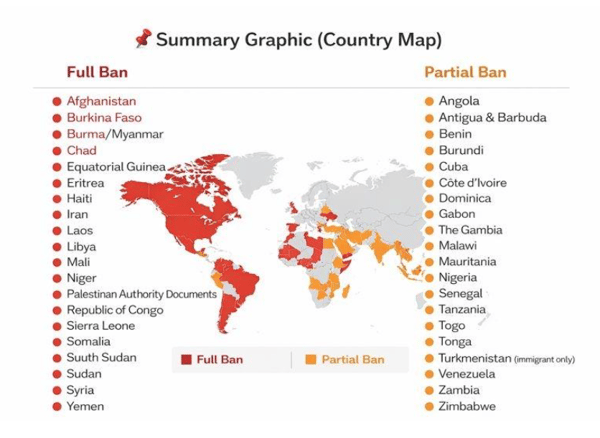
Please see below for a list of countries. Countries in red have full visa suspensions – These countries face complete suspension of all immigrant and non-immigrant visa issuances, preventing their citizens or nationals from obtaining any type of U.S. visa. Adjudications for benefit requests from these countries are also paused.
Countries in orange have restricted visa suspensions – These countries face suspension of all immigrant visa issuances, and suspension of non-immigrant visa issuance in the B-1, B-2, F, M, and J visa categories. Adjudications for impacted benefit requests are also paused.
Full visa suspension countries (Red):
Afghanistan Burkina Faso Burma (Myanmar) Chad Equatorial Guinea Eritrea Haiti Iran Laos Libya Mali Niger Palestinian Authority (travel documents) Republic of the Congo Sierra Leone Somalia South Sudan Sudan Syria Yemen
Restricted visa suspension countries (Orange):
Angola Antigua and Barbuda Benin Burundi Cuba Côte d’Ivoire Dominica Gabon The Gambia Malawi Mauritania Nigeria Senegal Tanzania Togo Tonga Turkmenistan (immigrant visas only) Venezuela Zambia Zimbabwe
4. Should you travel?
If your country of birth or citizenship is listed on the banned or restricted list and you are currently in the U.S., you SHOULD NOT travel internationally. If you are currently traveling and have a valid visa stamp to enter the U.S., you should return before January 1, 2026. Travel after that date may result in denial of entry.
5. Should you continue the EB-3 unskilled program?
Even with the changing immigration landscape, the EB-3 unskilled program remains one of the fastest and most versatile ways to obtain a green card. The travel ban does not impact labor certification (LC) approval or I-140 approval, and these processes will continue as normal.
For adjustment of status (AOS) clients who are currently in the U.S. in valid status, the travel ban does not impact your ability to file once your priority date is current, so long as you remain in the U.S.
For consular processing clients from impacted countries, there may be restrictions on your ability to obtain an immigrant visa when your priority date becomes current. In addition, adjudications for immigrant visa applications and related benefits are currently paused for impacted countries. Travel bans from prior administrations faced significant legal challenges, and the scope and duration of the current ban may change over time.
Even if you are from an impacted country, we recommend continuing the program. The EB-3 process takes several years, and the list of affected countries may be modified or lifted by the time your priority date becomes current.
6. Are dual citizens subject to the travel ban?
No. If you are a dual citizen or national of a banned country but are traveling on a valid passport from a non-banned country, you are generally exempt from the travel ban.
7. Are there any exceptions to the ban?
There are limited exceptions to the ban, including certain family-based cases, specific visa categories, humanitarian exceptions, and cases where entry serves a critical U.S. interest. These exceptions are narrow and do not apply to most foreign nationals. You should speak with your immigration attorney if you believe you may qualify for an exception.
8. Can countries be added to or taken off the list?
Yes. The proclamation requires periodic review of the country list by the U.S. Department of State and other agencies, generally within 90 days of issuance and every 180 days thereafter. Our attorneys and Government Relations Team will continue to monitor developments and provide updates as changes occur.
Additional questions? Reach out via chat if you have questions. Our attorneys are closely monitoring the situation and will continue to provide updates as this policy develops. We are here for you.
Leave a Reply