Student & Exchange Visas
Changes to F-1 and J-1 Visa Status: What You Need to Know
On hold: federal court injunction
Video + 3 min read
Chris Richardson, President & General Counsel of BDV Solutions, appeared live on September 15th for an important discussion about the new student visa regulations and duration of status. While the regulations were meant to take effect on September 15th, a US federal court issued an injunction stopping the new rules for now.
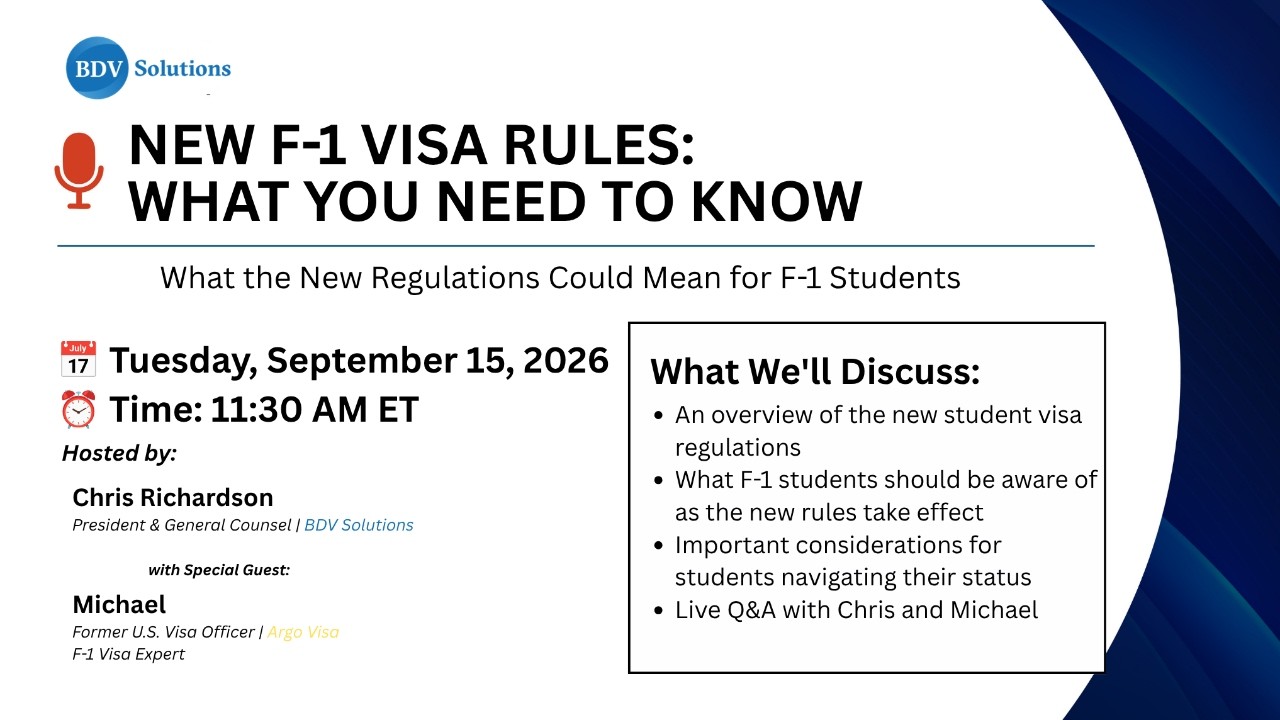
New F-1 Visa Rules: What You Need to Know
The Department of Homeland Security (DHS) has overhauled the rules governing F-1 international students and J-1 exchange visitors. If the federal courts eventually allow the new F-1 and J-1 rules to go into effect, it will change how these visa holders are admitted to the US, limit how long they can stay, and restrict changing programs or schools. It also will require F-1 and J-1 holders who wish to extend their stay to either file an extension of stay with USCIS or travel outside the U.S. and be re-admitted.
What’s Changing
For decades, F-1 and J-1 holders were admitted under “Duration of Status” (D/S), allowing them to remain in the U.S. as long as they maintained status. That ends September 15th.
Going forward, all F and J visa holders will receive a fixed Admit Until Date (AUD) — either their program end date or four years, whichever is shorter. The post-program grace period also shrinks, from 60 days to 30.
For Those Already in the U.S. in D/S on September 15, 2026
If you were admitted for D/S and are present in the U.S. on September 15, 2026, special transition rules apply:
- You may stay until your Program End Date (per your I-20 or DS-2019) or the end of post-completion/STEM OPT — but no later than November 14, 2030.
- Leaving and re-entering the U.S. on or after September 15, 2026 subjects you to the new AUD rules and the shortened 30-day grace period.
- OPT approved before September 15, 2026 may continue through its existing end date.
- Applying for post-completion OPT by March 18, 2027 requires only Form I-765. After that date — or if you’ve traveled internationally and re-entered — both Form I-765 and Form I-539 are required.
Extending Your Stay
If you need more time to finish a program, start a new one, or pursue practical training beyond your AUD, your DSO (F-1) or ARO (J-1) must first recommend the extension in SEVIS and issue an updated I-20 or DS-2019. You’ll then need to either file an I-539 with USCIS to extend your stay, or leave the U.S. and re-enter before your AUD expires.
Limits on Transferring Schools, Changing Your Program, and Other Restrictions
- Undergraduates generally can’t transfer schools or change programs before completing their first year, unless SEVP authorizes an exception for extenuating circumstances.
- Graduate students may not change programs or transfer schools, unless SEVP grants an exception for extenuating circumstances.
- After completing a U.S. degree, students may only advance to a higher degree level. Earning another degree at the same or lower level will not be permitted.
- English language training is now capped at 24 months total, including vacation periods.
Dependents (F-2/J-2)
Spouses’ and children’s permitted stay will normally be tied to yours. When you file to extend your own status, they generally need to extend theirs too.
What To Do Now
- Talk to your DSO or ARO as soon as possible to understand how this rule will affect your specific situation and timeline.
- File any needed applications timely and as early as possible. USCIS processing times can be lengthy, and gaps in your status can have serious consequences.
- Keep copies of all important documents, including your I-20 or DS-2019, all USCIS filing receipts, and any approval or denial notices.
This article is intended for general information purposes only and does not constitute legal advice. You should not act or rely on any information in this article without consulting a licensed immigration attorney. You can find a licensed attorney at www.ailalawyer.com.